




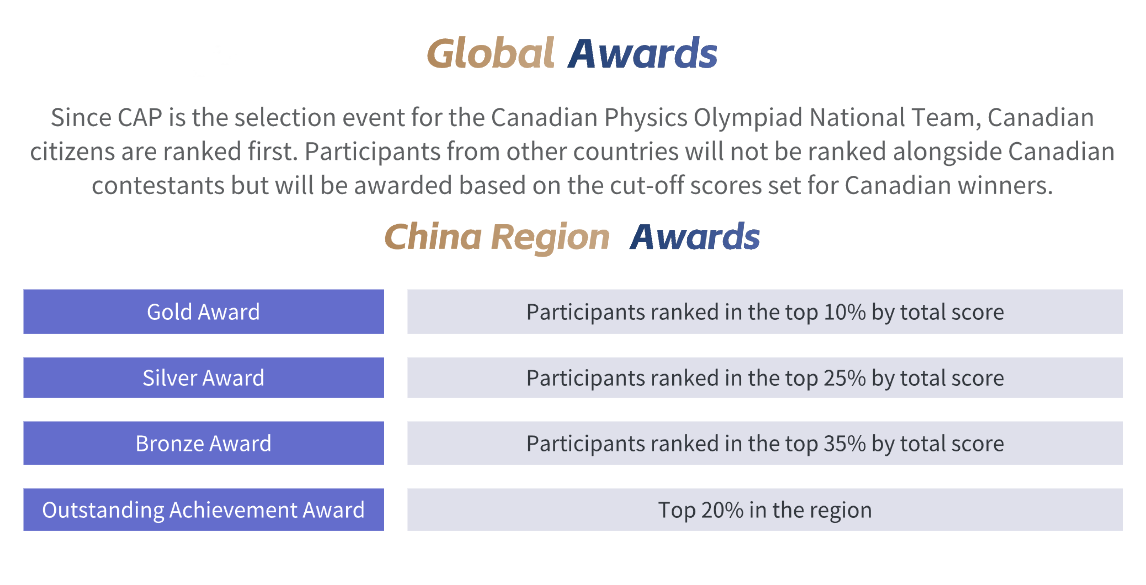


The CAP Prize Exam, a Canadian Physics Olympiad, is jointly organized by the Physics Society of Canada and the University of British Columbia (UBC). Since 1995, it has been Canada's highest-level high school physics competition and serves as the first round of selection for the national physics team. Approximately 2,000 students participate annually, with only 50-100 scoring over 50%. Awards are given in gold, silver, and bronze, as well as regional excellence awards. It is highly recognized by top North American universities and is a significant advantage for applications to physics/engineering programs.
The CAP competition, co-organized by the Canadian Physical Society (CAP) and the University of British Columbia (UBC), has served as the first round of selection for the Canadian national physics team since 1995 and is the highest-level high school physics competition in Canada. Each year, only 50-100 out of approximately 2000 participants score over 50%, highlighting the rigorous selection process. CAP scores are a core competitive advantage for STEM applications in North America, with prestigious universities such as MIT, Stanford, and the University of Toronto explicitly listing them as proof of academic potential. For Chinese students, the competition has a separate Asian division, with awards having the same weight as those in Canada, and currently offering a 1.8 times higher chance of winning compared to North America.
It involves the relationship between basic physical quantities such as displacement, velocity, acceleration, etc. For curved motion, it requires an understanding of projectile motion, circular motion, etc.
Newton's Laws:
Emphasis is on the application of Newton's second law.
Function and Energy:
Understand the definition of work (force, displacement, and the angle between the force and the displacement direction), and be able to calculate the work done by various forces (such as gravity, elastic force, friction, etc.).
Momentum and impulse:
Grasp the concept of momentum and understand the relationship between impulse and momentum change.
electric field:
Understanding the definition of electric field strength allows us to calculate the electric field strength generated by a point charge.
magnetic field :
Understand the concept of magnetic induction intensity and master the calculation of Ampere force and Lorentz force.
Circuit:
Master Ohm's law and be able to analyze the relationship between current, voltage, and resistance in series, parallel, and mixed circuits. Understand the definition of electric power.
Geometric optics :
Master the laws of reflection (angle of reflection equals angle of incidence) and refraction of light; understand the laws of lens imaging and be able to apply the thin lens imaging formula.
Wave Optics:
Understand the wave nature of light, such as interference and diffraction phenomena of light.
NEEC's US Study Abroad Program welcomes you to join us. Learn more about the background of the East Coast University Visit and Study Camp program. The East Coast refers to…
SICNEEC Competition Registration: Introduction to the SIC Economics Competition. SIC, or the Secondary School Investment Challenge, is a competition for...